Reducing administrative workload by using a Large Language Model (LLM) to automate tedious tasks to save time, increase employee satisfaction and standardize the administrative process.
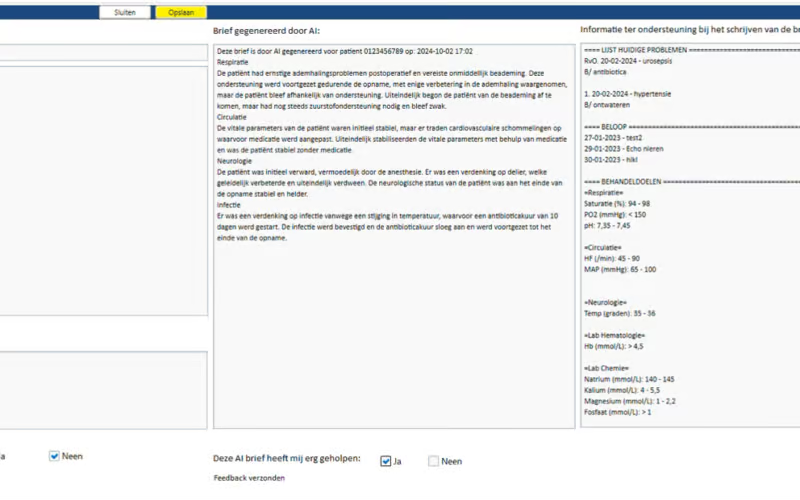
Reducing administrative workload by automatically generating a draft of the clinical course for the discharge letter using a Large Language Model (LLM).
When a patient is discharged from a department, a discharge letter must be written for the subsequent care provider, such as a general practitioner or another healthcare institution. Composing a discharge letter is a time-consuming task that takes on average about one hour per patient.
To speed up this process, we use GPT-4. This model runs on a European server within a secure environment managed by UMC Utrecht. OpenAI and Microsoft have no access to patient data, and the data is not used to improve the model.
Based on information from the patient’s record during admission, the model automatically generates a draft of the clinical course. The physician uses this draft when compiling the discharge letter, and it is always checked by a supervisor before being sent out.
Together with the Julius Center, we evaluated the algorithm for completeness, accuracy, and conciseness. Physicians in the ICU and NICU rated the AI-generated texts as equally useful compared to manually written versions. During the initial pilot, physicians also saved up to 20 minutes per letter on average, and they viewed the tool positively.
Current state
The tool is currently fully implemented in the ICU and NICU (see: https://research.umcutrecht.nl/ai-applications-in-use/). A pilot is currently being prepared for Cardiology.

Start of the pilot at the ICU
Developers: Laura Veerhoek, Ruben Peters (AI for Health)
ICU: Marc Platenkamp, Pieter van der Hoeven
NICU: Daniel Vijlbrief
Cardiology: Dino Ahmetagic, David Sprenkeler, Bauke Arends, Michiel Voskuil
Product Owner: Marjon Jose Smit (Zorg van Morgen)
The aim of this project is to support physicians in preparing for patient consultations, thereby reducing their administrative workload.
This product is part of the “AI voor Administratieve Lastenverlichting” (AIvA) project, which aims to reduce the administrative workload of healthcare providers within UMC Utrecht through the use of Artificial Intelligence (AI). Specifically, this product focuses on helping physicians prepare for patient consultations more efficiently.
Currently, physicians must manually review patient records before consultations and create their own summaries, which is time-consuming and can lead to information overload. Our application automates this process by automatically compiling relevant patient records and using large language models (LLMs) to generate concise and clear summaries. In addition, the application includes source references, clearly indicating which documents and passages have been used for the summary. This ensures transparency and traceability of the information.
By leveraging this technology, physicians are expected to work more efficiently, be better prepared for consultations, and spend less time on administrative tasks—allowing them to devote more time to direct patient care.
Current State
We are currently evaluating the first version of our application. The quality of AI-generated summaries is being compared to manually created summaries by anesthesiologists. The goal of this evaluation is to assess how accurate and reliable the AI summaries are, and to determine whether important diagnoses are included correctly and completely or if any information is missed. After completing this evaluation phase, necessary adjustments will be made to further improve the quality and usability of the application, after which we will move forward to a pilot phase.
Developers: Sjoerd de Vries, Eric Wolters, Laura Veerhoek (AI for Health)
Anesthesiologist: Marije Marsman
Clinical and Performance Evaluation Manager: Ruurd Kuiper (Julius Center)