Clinical decision support (CDS) using artificial intelligence leverages advanced algorithms and machine learning to assist healthcare professionals in making more accurate, timely, and personalized medical decisions. By analyzing vast amounts of patient data, medical literature, and real-world evidence, AI-powered CDS systems can identify patterns, predict outcomes, and suggest evidence-based interventions. This technology aims to enhance diagnostic accuracy, improve treatment planning, and ultimately support better patient outcomes while reducing the cognitive burden on clinicians.
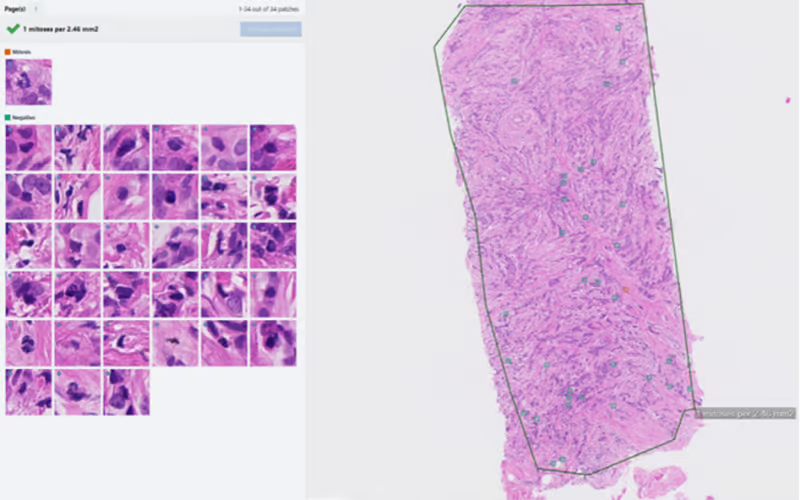
Using a combiantion of a geometric algorithm and a neural network to assist in the scoring of mitoses on whole slide images.
In this project, we have developed a tool to assist pathologists in counting the number of mitoses in whole slide images of breast tissue. This is an important step in determining the grade of a tumor and is a time-intensive process.
Using a neural network, we detect possible mitoses on digital images. The region with the highest density of mitoses is automatically identified by means of a geometric algorithm and then returned to the pathologist via the PACS. The system subsequently presents potential mitoses to the pathologist, who can easily indicate for each suggestion whether it is indeed a mitosis.
By using this tool, we hope to achieve more consistent scoring, ultimately leading to improved patient care. We also aim for a modest time and cost reduction.
Current State
The geometric algorithm, the detection model, and the PACS integration have been completed. We are currently testing whether the scoring is indeed more consistent in a pilot study with several pathologists
Developers: Sjoerd de Vries (AI for Health), Nikolas Stathonikos (Digital Pathology), Paul Pham (Digital Pathology)
Pathologists: Annelotte Vos, Jan Erik Freund, Paul van Diest
Commissioned by: Paul van Diest
Graves’ disease is an autoimmune disorder of the thyroid gland. It causes hyperthyroidism, which can lead to unpleasant symptoms such as palpitations, fatigue, weight loss, and excessive sweating. The disease most commonly affects women between the ages of 20 and 40—a busy phase of life, where it helps if managing their condition does not become the main focus.
The algorithm calculates the required medication adjustment based on a measured lab value. The automatically calculated dosage is immediately available and can be relayed to the patient via an app, eliminating the need for a (telephone) appointment with a physician.
This means both the patient and the physician spend less time on manual steps, while care becomes more standardized.
Current State
The project is currently in the exploratory phase.
Developers: Laura Veerhoek, Marieke van der Feen (AI for Health)
Endocrinology: Fleur Weeber, Toke Keyser